SKU
10041402970000

The Sower - Myths and Wealth
5€ 1/2g Gold coin - Croesus - Proof Quality Yeardate 2026

€135.00
More Information
Diameter 11 mm
Weight 0.5 g
Qualité Proof
La qualité "Belle Épreuve" est la plus haute qualité numismatique devant les qualités "Brillant Universel" (BU) et "courante". Une pièce belle épreuve est une pièce obtenue au moyen de coins et de flans spécialement préparés et de conditions de frappe particulières, de sorte que les motifs de gravure ressortent avec une grande netteté et que la surface est sans défaut. Les fonds de la gravure sont extrêmement brillants, les reliefs sont matés.
Mintage 1500
Millésime 2026
Valeur faciale 5€
The figure of Croesus dates back to the 6th century BCE, when he ruled Lydia in Asia Minor. His story is mainly known through the accounts of Herodotus. Croesus appears as a ruler of exceptional wealth, which became legendary thanks to the gold of...
Coming soon
main product photo
The Sower - Myths and Wealth 5€ 1/2g Gold coin - Croesus Proof Quality Yeardate 2026
€135.00

    Description

    The figure of Croesus dates back to the 6th century BCE, when he ruled Lydia in Asia Minor. His story is mainly known through the accounts of Herodotus. Croesus appears as a ruler of exceptional wealth, which became legendary thanks to the gold of the Pactolus River, trade, and the prosperity of his kingdom. He receives a visit from Solon, who reminds him that happiness can only be judged at the end of life. Later, defeated by Cyrus the Great, he loses his kingdom and his power. According to legend, he was even condemned to be burned at the stake. Over time, Croesus thus becomes a symbol of wealth, but also of the fragility of fortune and power.

    On the obverse of this coin is an original composition by Chief Engraver Joaquin Jimenez. In the foreground is the portrait of Croesus, depicted with a laurel crown symbolizing his power. In the background appears Cyrus the Great, the Persian king who, according to legend, condemned Croesus to be burned at the stake. On the side, the gold of Croesus’ staters flows along the Pactolus River.

    On the reverse, there is a modernized adaptation of the “Semeuse” by engraver Louis-Oscar Roty, with a heraldic version of the French flag appearing on the drapery of her dress. The “RF” inscription is also surrounded by an interlacing of hexagons recalling France.
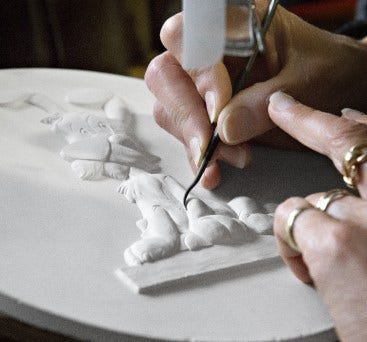
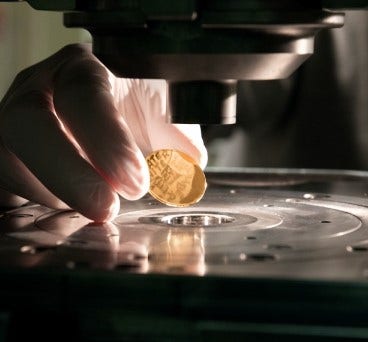
    Our craftman

    • THE ENGRAVER

      Trained at the best schools, they have the years of experience behind them necessary to master all aspects of the craft. Using industrial oil-based modelling clay and working from a design executed freehand or with CAD software, they skilfully fashion a low relief model in order to enhance the engraving and the way it catches the light. They work alternately with concave and convex plaster moulds until satisfied they have achieved the best 3D rendering of the design.

    • THE MINTER

      The first minters began to ply their trade in France when striking with a hammer appeared in the 4th century BC. Nowdays, minsters use press instead of a hammer. Their knowledge of dies, engraving and metals, and their expertise - passed seamlessly down from one generation to the next for centuries - guarantees the excellence of their work.

    Loading Oney widget...