A year ahead of the European celebrations marking the Norman Millennium in 2027, the Monnaie de Paris is honouring the victory of the Norman forces over the English at Hastings in 1066. A decisive battle in the campaign to conquer England, Hasting...
Show all products in the collectionAll products in the collectionHide all products in the collection
(5)
960 year of Hastings battle 1/4€ coin Circulating quality Yeardate 2026
€5.99
Description
A year ahead of the European celebrations marking the Norman Millennium in 2027, the Monnaie de Paris is honouring the victory of the Norman forces over the English at Hastings in 1066. A decisive battle in the campaign to conquer England, Hastings marked a turning point in history, ushering in the Anglo-Norman period.
The obverse of this coin features William, known as ‘the Conqueror’, about to be crowned as William I, King of England. Seated on the throne of Edward the Confessor in Westminster Abbey, William holds in his left hand a sceptre, a symbol of royal power.
The reverse depicts a key scene from the Bayeux Tapestry, in which Norman horsemen charge the English infantry on the Sussex hills at Hastings. The success of this offensive was decisive in the Normans’ victory in the conquest of England.
Our craftman
THE ENGRAVER
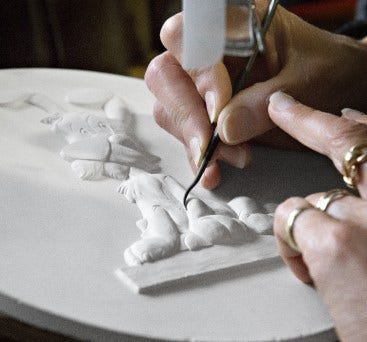
Trained at the best schools, they have the years of experience behind them necessary to master all aspects of the craft. Using industrial oil-based modelling clay and working from a design executed freehand or with CAD software, they skilfully fashion a low relief model in order to enhance the engraving and the way it catches the light. They work alternately with concave and convex plaster moulds until satisfied they have achieved the best 3D rendering of the design.
THE MINTER
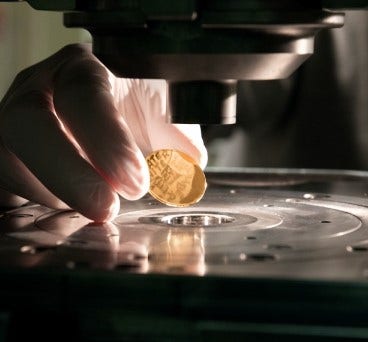
The first minters began to ply their trade in France when striking with a hammer appeared in the 4th century BC. Nowdays, minsters use press instead of a hammer. Their knowledge of dies, engraving and metals, and their expertise - passed seamlessly down from one generation to the next for centuries - guarantees the excellence of their work.
I agree to my personal data being used to create custom audiences for communication and targeted advertising purposes, and similar audiences on platforms (such as Meta, Google, etc.) for marketing analysis and profiling purposes. I agree to my data being shared with marketing agencies for these purposes. For more information, please see our Privacy and Personal Data Protection Policy.
Loading Oney widget...
... YIKES!
Your web browser is not supported by this site, please update it.
We invite you to update it to have an optimal and secured experience.